Offering of financial investments: atypical products and different goods - CONSOB AND ITS ACTIVITIES

Menu
What are the investments having a financial nature?
Investments having a financial nature are "atypical" forms of investments, different from the financial instruments referred to in the Article no. 1 of the Italian Consolidated Law on Finance (TUF). The same article defines "financial products" as " financial instruments [typified forms of investment] and any other form of investment having a financial nature ...".
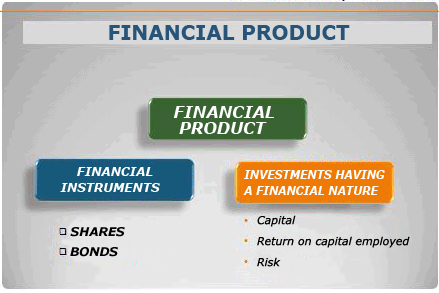
The elements qualifying the notion of investment of a financial nature can be found in the co-presence of: (i) a capital investment; (ii) a financial return expectation; (iii) the assumption of a risk directly connected and related to the use of capital. Investments having a financial nature constitute a species of the FINANCIAL PRODUCT genus.
The elements of the "financial nature" of an operation are to be found in the objective agreements / contractual mechanisms (therefore, they are intrinsic elements of the operation), not in the will/subjective reason pushing the buyer to invest his money in an operation, given that the aim of making a profit exists both in the financial operations properly said and in the operations of an eminently commercial nature.
Investment contracts therefore have a financial cause. As established by the Italian Corte di Cassazione, "The cause of a contract is of a financial nature [when] the objective reason of the contract, and not its simple subjective reason without qualifying relevance, consists precisely in the investment of the capital (the" block"of the savings) with the perspective of increasing the capital invested, without a service by the investor other than giving a sum of money"(the Italian Corte di Cassazione, Section II Civ., ruling no. 2736 of 2013).
The contractual proposals concerning investments having a financial nature may have different types of goods as "underlying" assets.
For example, if I buy a painting at the price of 9,000 Euros and the seller undertakes to buy it back at a higher price (e.g. 10,000 Euros) at a certain expiry (e.g. after a year) the difference between the purchase price and the sale price (1,000 Euros) is the return on my investment, as it happens in case of purchase of a government bond such as the Italian BOT (Ordinary Treasury Bill) or a boundless coupon ("zero-coupon" type). The cause of the contract is purely financial and, only apparently, can be found in the purchase of the good for enjoyment purposes.
What should you do for making an offering of financial products to the public?
The Italian Consolidated Law on Finance – TUF, (Articles no. 94 and following) obliges the subject that intends to make an offering of financial products to the public to draw up a prospectus, a document containing a whole series of useful information for the investor. The prospectus must be approved by CONSOB which verifies the completeness, consistency and comprehensibility of the information provided.
Is the prospectus always mandatory?
No, there are cases of exemption. In this regard, the Article no. 34-ter of Consob Issuers Regulation provides for exemption hypotheses, among which the one related to the total value of the offering calculated within the European Union in the last twelve months which must not exceed 8 million Euros , and the one related to the offerings addressing fewer than 150 subjects. With reference to the latter, it should be noted that the offerings carried out via the internet channel are to be considered, due to the nature of the channel used - without prejudice to specific safeguards possibly adopted by the proposer - addressed to a generalized and indistinct audience of subjects, higher than the exemption threshold of 150 subjects.
PLEASE NOTE: To consult the list of prospectuses authorized by Consob click here.
Abusive offerings of investments having a financial nature
Those who aim to collect money from investors resort to ever new contractual schemes in which the investor is sometimes required to carry out alleged working activities. This in order to give the initiative a resemblance of lawfulness, which they often do not have. These initiatives are characterized by the promise of particularly high returns in terms of percentage and time due to earn them. The first element that all these initiatives have in common, regardless of the type of the underlying asset, is in fact the promise of extremely high returns.
The most popular contractual schemes
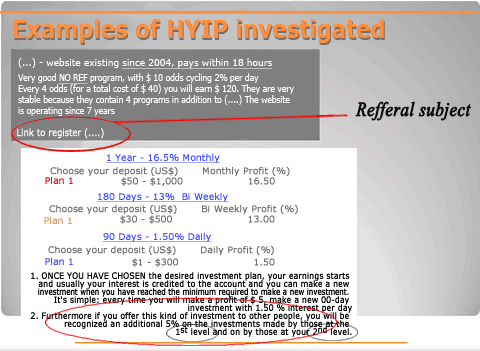
The HIGH YIELD INVESTMENT PROGRAMS are characterized by the promise of a very high return (even 2% per day) for the achievement of which the investor is asked to provide a very small capital (even 5 o10 Euros).
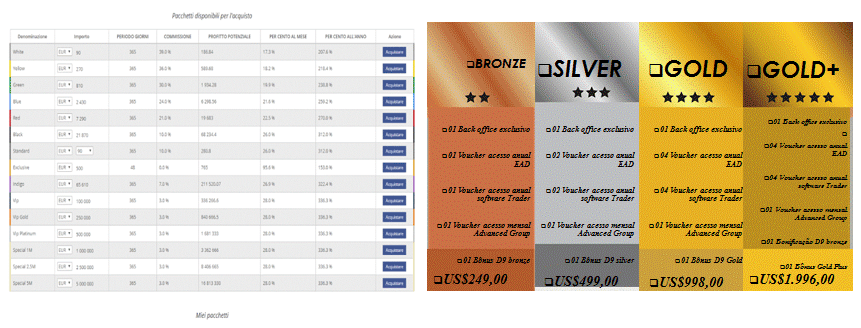
THE INVESTMENT PACKAGES variously denominated (e.g. advertising packages) require the investor to pay sums of money that can vary from a few hundred to some thousand Euros. The amount of the package may vary according to the services connected to it or, sometimes, to the content of the (insignificant) activity the investor is requested to perform. This is the case, for example, of the "pay to click" initiatives. To distinguish among the packages, the promoter generally makes use of names that recall "colours" (black, red, yellow, white, etc ...) or precious metals (bronze, silver, gold, gold +, diamond ...),
The PARTICIPATION ASSOCIATION AGREEMENTS, often used by companies that propose investments, request the investor to provide a sum of money – which can reach some tens of thousands of Euros - to finance the activity of the company which, in turn, undertakes to pay the investor, at pre-established deadlines, a profit identified in predefined measure or based on certain parameters, also guaranteeing the return of the invested capital.
CONTRACTS RELATED TO THE ALLEGED SALE OF VALUABLE GOODS There have been cases of companies offering potential clients the possibility of investing in "packages" for the purchase of diamonds/gold ingots and coins with the promise - by the companies - of predetermined periodic returns and the possibility for the investor to also get back the sums paid for the alleged purchase of the asset without ever coming into possession of the asset itself.
PLEASE NOTE: To consult the suspension and prohibition measures taken by CONSOB against those entities which carried out an offering of financial products to the public in the absence of a prospectus, as well as against the subjects that carried out the connected advertising activities click here.